FaceBook and Google has not yet announced this officially, some persons are exposure that status updates from FaceBook pages will start viewing up on Google search results today.
And so the race to happen to a real time search engine is opening to warm up. Google of course was forward of the game as it included Twitter updates to search results near the beginning December last year. While recently, it has also started incorporating MySpace status updates.Of course, this comes hot on the heels of Yahoo’s statement of their content sharing transaction with Twitter.
But while Google’s compact with Twitter and MySpace includes status updates of members, the deal with Facebook is limited only to status updates of Facebook pages. Of course this is reasonable since Facebook has a much closer ties with Microsoft Bing.
And in case you’re not aware Facebook pages are generally accounts used for marketing and promotion purposes of purchaser brands so, there’s really not much real time in this observe since those Facebook pages are rarely updated after all.
Makes me marvelous right now, as to when Google will integrate updates coming from Google Buzz to search results. Although I’m not really hoping that they would.
Thursday, February 25, 2010

Wednesday, February 17, 2010
Why Content on a Website is So Important
I am sure you have heard it everywhere you go on how important content is in this industry and how it is the impelling force to any successful search engine marketing campaign.
It is important to an idea exactly how the search engines work. I know many people like to keep their websites clean and clutter less but the search engines are not artificial intelligence activity. They are readers they read massive amounts of information in a split second and find the most relevant information they can in order to supply the search user with what they need. With that said the better the content the easier the search engine crawlers can find your business. If you don’t have enough content they don’t have enough to read and your rankings will slip a bit. Text is the search spider’s food. You have to feed them with good quality content and over time you will be honored with better and faster indexing.

That doesn’t mean you have to fill each page of your website with thousands of words either. Make a prepared business result with how much content you need to provide for your users to do what they need to do. If you have product pages that need content a hundred to a hundred fifty words will work. You don’t need to drop a thousand words so the search engines can find you. Think about your user knowledge as well. If you own a website that sells t-shirts do you want to have a thousand words on your product page? Probably not because nobody wants to sit there and feel like they have to read all that but if you are a business to business entity and you offer technical database solutions to your audience than a lengthy description of your services or products might be in order. Think about your spectators and step into their shoes.
Take a step back and figure out exactly what your spectators is like and what they want to see on your website before you think about what the search engines want to see. Your audience is more essential, they are the ones that are going to purchase from you not the search engines. The search engines are just there to display the information in the best possible fashion.
It is important to an idea exactly how the search engines work. I know many people like to keep their websites clean and clutter less but the search engines are not artificial intelligence activity. They are readers they read massive amounts of information in a split second and find the most relevant information they can in order to supply the search user with what they need. With that said the better the content the easier the search engine crawlers can find your business. If you don’t have enough content they don’t have enough to read and your rankings will slip a bit. Text is the search spider’s food. You have to feed them with good quality content and over time you will be honored with better and faster indexing.

That doesn’t mean you have to fill each page of your website with thousands of words either. Make a prepared business result with how much content you need to provide for your users to do what they need to do. If you have product pages that need content a hundred to a hundred fifty words will work. You don’t need to drop a thousand words so the search engines can find you. Think about your user knowledge as well. If you own a website that sells t-shirts do you want to have a thousand words on your product page? Probably not because nobody wants to sit there and feel like they have to read all that but if you are a business to business entity and you offer technical database solutions to your audience than a lengthy description of your services or products might be in order. Think about your spectators and step into their shoes.
Take a step back and figure out exactly what your spectators is like and what they want to see on your website before you think about what the search engines want to see. Your audience is more essential, they are the ones that are going to purchase from you not the search engines. The search engines are just there to display the information in the best possible fashion.
Thursday, February 11, 2010
On Potential Privacy Problems With Gmail Buzz Exposing Email Contacts
Author: Philipp Lenssen
Publisher: Google Blogoscoped
Nicholas Carlson of Business Insider calls Gmail Buzz’s (apparently default-settings) exposure of some of those you are in contact with – by auto-suggesting people to follow, and displaying that list on your public profile – a “huge privacy flaw”:
In my profession – where anonymous sourcing is a crucial tool – the implications of this flaw are terrifying.
But it’s bad for others too. Two obvious scenarios come to mind:
* Imagine if a wife discovering that her husband emails and chats with an old girlfriend a ton.
* Imagine a boss discovers a subordinate emails with executives at a competitor.
Now, you can turn off showing your contacts publicly in your profile settings. And you can also unfollow people suggested to you before finalizing your Buzz settings (though, using dummy accounts just now, I wasn’t able to properly test whether Google indeed wouldn’t expose your contacts in the time after logging in to Buzz and before finalizing your settings, if you already have a public profile. In one test I also signed up with Buzz without it creating a public profile. Does anyone know more?). And you may decide not to click that “okay” button in Buzz to begin with.
But Google should really consider to make showing people you follow an opt-in setting, or reword their interface to make it absolutely clear (i.e. more than a gray footnote) that you might expose who you’re emailing with. So already, we’re seeing the first privacy issues of mixing Buzz and Email the way Google does. Unless we’re following Eric Schmidt’s angle, that is: if you got something you don’t want anyone to know, maybe you shouldn’t be doing it in the first place. Like a journalist keeping their sources anonymous?
Publisher: Google Blogoscoped
Nicholas Carlson of Business Insider calls Gmail Buzz’s (apparently default-settings) exposure of some of those you are in contact with – by auto-suggesting people to follow, and displaying that list on your public profile – a “huge privacy flaw”:
In my profession – where anonymous sourcing is a crucial tool – the implications of this flaw are terrifying.
But it’s bad for others too. Two obvious scenarios come to mind:
* Imagine if a wife discovering that her husband emails and chats with an old girlfriend a ton.
* Imagine a boss discovers a subordinate emails with executives at a competitor.
Now, you can turn off showing your contacts publicly in your profile settings. And you can also unfollow people suggested to you before finalizing your Buzz settings (though, using dummy accounts just now, I wasn’t able to properly test whether Google indeed wouldn’t expose your contacts in the time after logging in to Buzz and before finalizing your settings, if you already have a public profile. In one test I also signed up with Buzz without it creating a public profile. Does anyone know more?). And you may decide not to click that “okay” button in Buzz to begin with.
But Google should really consider to make showing people you follow an opt-in setting, or reword their interface to make it absolutely clear (i.e. more than a gray footnote) that you might expose who you’re emailing with. So already, we’re seeing the first privacy issues of mixing Buzz and Email the way Google does. Unless we’re following Eric Schmidt’s angle, that is: if you got something you don’t want anyone to know, maybe you shouldn’t be doing it in the first place. Like a journalist keeping their sources anonymous?
Checking Out Gmail Buzz
publisher: Google Blogoscoped by Philipp Lenssen
Just got Buzz rolled out to my Gmail account. The first step was to pick who to follow, which feeds to connect to your account, and to check who follows you. From the 150+ people suggested to me to auto-follow I unchecked quite a few, for one thing, I don’t want my public profile to show this social network (if I understood Google’s wording right, then “people you follow” will show on your profile, and it must be public). I also unchecked family members. If this is going to be a type of Friendfeed, then I want to have other discussions on it.
Note there’s a bug in Buzz that when you unsubscribe from someone in the intro settings dialog, you still need to refresh the page, apparently – I was presented with a whole lot of items from people I wasn’t suscribed to per the first dialog, including the option to unsubscribe from them.

My first impression after saving my settings and loading the buzz stream: Alright, yeah, this is just like Friendfeed. My second impression: Google didn’t copy enough from Friendfeed. For instance, Friendfeed automatically collapses large discussions, which makes it easy to scan the whole page. Gmail on the other hand showed me discussion after discussion in full view, making for long scrolling and a noisy feeling. However, later on when I refreshed the page, the discussions were collapsed fine in Buzz. At first, I also didn’t like how Gmail presents the name first – in bold blue nonetheless – and the comment of the person second; Friendfeed feels much more well-aligned and uncluttered. The latter, however, may simply be something I’m used to in Friendfeed (in typical chat clients like mIRC, the name is presented first, too, and it feels natural there).
Another detail: in buzz, I can Like my own messages. Which seems odd, at least at first (Friendfeed doesn’t offer such a thing, as far as I’m aware).
I now went to post my first Buzz message. I’m learning that 181 people are following me, and I can choose between making a Public (“Let anyone find and read your posts”) or a Private post (“Keep your posts restricted and only visible to the people you choose”). My first message is related to asking where exactly my message will appear, and whether it’ll make it to the inbox too...

But... ouch. I don’t want these types of discussions to take over my inbox. Perhaps others have different use cases where they’d want that, but too me emails are often connected to very different tasks. A post (buzz?) by Google employee John Mueller points me to another page – a permalinked buzz post – which suggests that in order to keep the inbox clean you need to...
Create a filter for the words “is:buzz” (ignore the warning) and filter to archive or trash as fits your needs. All gone out of the Inbox.

So, Buzz is quiet for now, and I will click it in the future to see how interesting the discussions in it are. All the software details aside, what I like about Friendfeed are the smart posts and comments over there (and conversely what I dislike about Friendfeed are when there’s no discussion on items I find interesting). In the end, that could be what determines if Buzz is interesting to me, too.
What are your first impressions?
Just got Buzz rolled out to my Gmail account. The first step was to pick who to follow, which feeds to connect to your account, and to check who follows you. From the 150+ people suggested to me to auto-follow I unchecked quite a few, for one thing, I don’t want my public profile to show this social network (if I understood Google’s wording right, then “people you follow” will show on your profile, and it must be public). I also unchecked family members. If this is going to be a type of Friendfeed, then I want to have other discussions on it.
Note there’s a bug in Buzz that when you unsubscribe from someone in the intro settings dialog, you still need to refresh the page, apparently – I was presented with a whole lot of items from people I wasn’t suscribed to per the first dialog, including the option to unsubscribe from them.
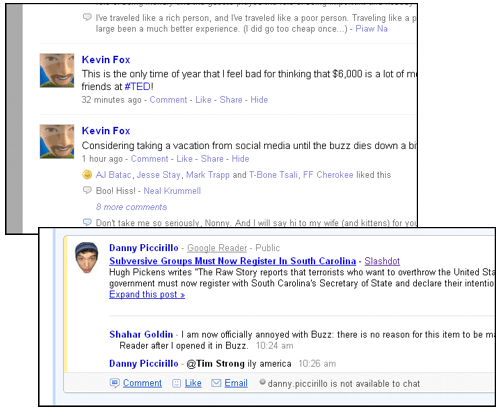
My first impression after saving my settings and loading the buzz stream: Alright, yeah, this is just like Friendfeed. My second impression: Google didn’t copy enough from Friendfeed. For instance, Friendfeed automatically collapses large discussions, which makes it easy to scan the whole page. Gmail on the other hand showed me discussion after discussion in full view, making for long scrolling and a noisy feeling. However, later on when I refreshed the page, the discussions were collapsed fine in Buzz. At first, I also didn’t like how Gmail presents the name first – in bold blue nonetheless – and the comment of the person second; Friendfeed feels much more well-aligned and uncluttered. The latter, however, may simply be something I’m used to in Friendfeed (in typical chat clients like mIRC, the name is presented first, too, and it feels natural there).
Another detail: in buzz, I can Like my own messages. Which seems odd, at least at first (Friendfeed doesn’t offer such a thing, as far as I’m aware).
I now went to post my first Buzz message. I’m learning that 181 people are following me, and I can choose between making a Public (“Let anyone find and read your posts”) or a Private post (“Keep your posts restricted and only visible to the people you choose”). My first message is related to asking where exactly my message will appear, and whether it’ll make it to the inbox too...
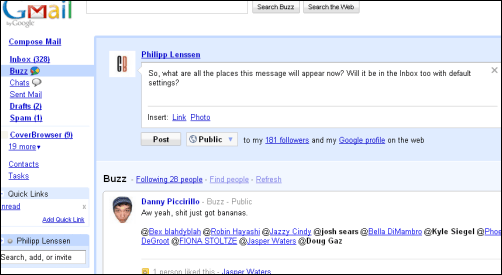
But... ouch. I don’t want these types of discussions to take over my inbox. Perhaps others have different use cases where they’d want that, but too me emails are often connected to very different tasks. A post (buzz?) by Google employee John Mueller points me to another page – a permalinked buzz post – which suggests that in order to keep the inbox clean you need to...
Create a filter for the words “is:buzz” (ignore the warning) and filter to archive or trash as fits your needs. All gone out of the Inbox.

So, Buzz is quiet for now, and I will click it in the future to see how interesting the discussions in it are. All the software details aside, what I like about Friendfeed are the smart posts and comments over there (and conversely what I dislike about Friendfeed are when there’s no discussion on items I find interesting). In the end, that could be what determines if Buzz is interesting to me, too.
What are your first impressions?
Differences Between MySpace and Facebook Users
By Manoj Jasra
comScore's recent digital year in review reveals that the MySpace demographic has gotten younger over the last year whereas Facebook's 24 & under crowd decreased and its 25-34 year segment increased.
An analysis of demographic composition of Facebook, MySpace and Twitter users revealed important differences that reflect their appeal to various audiences. MySpace saw its user composition shift toward younger audience segments in 2009, with people age 24 and younger now comprising 44.4 percent of the site’s audience, up more than 7 percentage points from the previous year. Facebook’s audience, by contrast, was evenly split between those younger and older than 35 years of age. The most noticeable demographic shift on Facebook during the year occurred with 25-34 year olds, who now account for 23 percent of the audience, up from 18.8 percent last year.

comScore's recent digital year in review reveals that the MySpace demographic has gotten younger over the last year whereas Facebook's 24 & under crowd decreased and its 25-34 year segment increased.
An analysis of demographic composition of Facebook, MySpace and Twitter users revealed important differences that reflect their appeal to various audiences. MySpace saw its user composition shift toward younger audience segments in 2009, with people age 24 and younger now comprising 44.4 percent of the site’s audience, up more than 7 percentage points from the previous year. Facebook’s audience, by contrast, was evenly split between those younger and older than 35 years of age. The most noticeable demographic shift on Facebook during the year occurred with 25-34 year olds, who now account for 23 percent of the audience, up from 18.8 percent last year.
Subscribe to:
Posts (Atom)